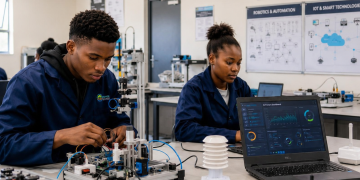






Young people seeking practical skills in emerging technologies have a new opportunity as applications open for the 2026 Fourth Industrial Revolution (4IR) Training Programmes in Mechatronics and the Internet of Things (IoT).
- Young people seeking practical skills in emerging technologies have a new opportunity as applications open for the 2026 Fourth Industrial...
- The training initiative, hosted by Vhembe TVET College in South Africa, aims to equip participants with hands-on technical skills in...
- Mechatronics combines mechanical, electronic and computer engineering principles, making it a valuable skill set for modern manufacturing and engineering environments.
- The Mechatronics training programme will accommodate 50 participants and is scheduled to begin on 1 July 2026.
Keep reading for the full breakdown on 4IR training — everything you need to know is covered below.
The training initiative, hosted by Vhembe TVET College in South Africa, aims to equip participants with hands-on technical skills in two fast-growing technology fields.
The programme will offer training to 100 learners, with places evenly divided between Mechatronics and IoT development courses. Applications close on 24 June 2026.



Focus on Future Technology Skills
The Fourth Industrial Revolution continues to reshape industries through automation, robotics, artificial intelligence, connected devices and smart manufacturing systems. As organisations increasingly adopt digital technologies, demand for workers with practical technical expertise is rising across sectors.
The Mechatronics programme focuses on robotics and automation, providing participants with exposure to automated machinery, control systems, and industrial processes. Mechatronics combines mechanical, electronic and computer engineering principles, making it a valuable skill set for modern manufacturing and engineering environments.
Alongside this, the Internet of Things Developer programme will introduce participants to connected devices, data collection systems and smart technology applications. IoT technology enables devices and machines to communicate and exchange information, supporting innovation across industries ranging from agriculture and healthcare to logistics and manufacturing.
Eligibility and Training Schedule
According to programme information, applicants must possess a Grade 12 qualification or higher. Candidates are also expected to have studied Mathematics and Physical Science and demonstrate an interest in technology and digital innovation.

The Mechatronics training programme will accommodate 50 participants and is scheduled to begin on 1 July 2026. The IoT Developer course, which also has 50 available places, is expected to commence on 1 October 2026. Both programmes will run for three months.
Training will take place at the Makwarela Campus of Vhembe TVET College in Limpopo, South Africa. Participants who successfully complete the courses will receive certification that may strengthen their employment prospects in technology-related fields.
Growing Demand for Mechatronics and IoT Expertise
Industry experts continue to highlight the growing importance of automation, robotics and connected technologies in modern workplaces. Mechatronics specialists are increasingly in demand across manufacturing, engineering services, food processing, oil and gas, and other industrial sectors. Similarly, IoT professionals are helping organisations build smart systems that improve efficiency, monitoring and decision-making.
With applications now open, aspiring technologists and engineering enthusiasts have an opportunity to gain practical exposure to some of the technologies driving the next phase of industrial transformation.
Interested candidates are encouraged to submit their applications before the 24 June 2026 deadline.
To apply, submit your CV via email to timesheet@vhembecollege.edu.za