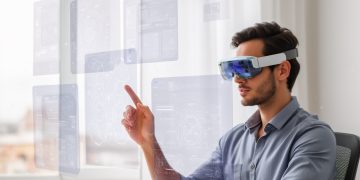






Augmented Reality is here, no longer just a thing of the future, confined to games or the occasional lab experiment. As AR glasses become lighter, more capable, and on the verge of widespread adoption, a new role is emerging: the Augmented Reality UX Designer, also known as a spatial designer.
- Augmented Reality is here, no longer just a thing of the future, confined to games or the occasional lab experiment.
- As AR glasses become lighter, more capable, and on the verge of widespread adoption, a new role is emerging: the...
- As hardware advances and adoption increases, businesses are seeking designers who grasp how people interact within three-dimensional spaces, not just...
- Designers who can adapt traditional UX principles to Apple’s spatial environment are increasingly in demand.
Keep reading for the full breakdown on 3D Design — everything you need to know is covered below.
This shift represents a significant opportunity for UX/UI designers and graphic designers, marking a significant change in immersive design.
From Screens to Space: The Rise of Spatial Computing Jobs
Traditional UX design has always been about flat surfaces: phones, tablets, and computers. Augmented Reality, however, upends that. Spatial computing integrates digital interfaces into the physical world, superimposing them on the objects surrounding us. Users aren’t just tapping screens anymore; they’re moving, gesturing, and engaging with the space itself.



A surge in demand for spatial computing professionals fuels this shift. Major players such as Apple, Meta, and Microsoft are investing in AR platforms, while startups are developing applications across education, healthcare, retail, manufacturing, and entertainment. As hardware advances and adoption increases, businesses are seeking designers who grasp how people interact within three-dimensional spaces, not just on flat screens.
Apple Vision Pro and the New Design Paradigm
Apple’s move into Augmented Reality has certainly stirred things up. The Apple Vision Pro’s design guidelines are a whole new approach, introducing an interaction language that centres on depth, gaze, hand movements, and a keen sense of space. Forget buttons and menus; designers are now dealing with floating windows, interfaces that track your gaze, and content that feels like it’s part of the physical world.
For UX/UI designers, this means a reset. Some things need to be unlearned, while others need to be expanded upon. Visual hierarchy is still essential, but it’s now layered in three dimensions.
Accessibility goes beyond contrast and font size; it encompasses comfort, motion sensitivity, and spatial clarity. Designers who can adapt traditional UX principles to Apple’s spatial environment are increasingly in demand.

Tools of the Trade: Unity for AR and Beyond
A top-tier AR UX designer doesn’t need to be a full-fledged developer, but a solid grasp of technical concepts is becoming essential. Unity has solidified its position as a fundamental tool for prototyping and constructing immersive experiences across various platforms. It enables designers to experiment with interactions, simulate environments, and work closely with engineers.
In addition to Unity, spatial designers frequently use tools such as Reality Composer, Blender, and Figma (for spatial mockups), as well as AR SDKs like ARKit and ARCore. Graphic artists venturing into this space can gain a competitive advantage by expanding their skill set to include 3D composition, lighting, and motion—crucial components for creating convincing AR experiences.
AR UX/UI Salary and Career Outlook
Designers frequently enquire about pay. Although salaries vary by location and experience, AR UX/UI positions typically offer higher compensation than standard UX roles, reflecting the specialised skills required. Even entry-level spatial designers receive attractive salaries.
Those with experience in AR platforms or mixed-reality products can earn considerably more, particularly in international or remote roles.
The career path is also promising. As immersive design evolves, early adopters of AR UX are establishing themselves as specialists, leaders, and creative directors within a rapidly expanding industry.
Why UX Designers and Graphic Artists Should Pay Attention
For UX/UI designers and graphic artists, Augmented Reality is a double-edged sword: both a challenge and an opportunity. The core skills you already possess—user research, visual storytelling, interaction design—remain essential. The difference lies in the medium. You’re no longer designing for a screen; you’re creating within the user’s environment.
As AR glasses transition from gimmicks to commonplace devices, spatial designers will influence how we work, learn, shop, and interact. Those who begin cultivating AR skills today won’t just keep pace with the evolving design landscape; they’ll actively shape it.