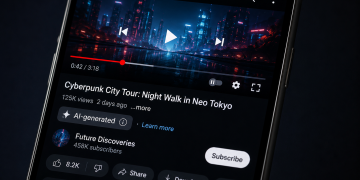






YouTube is taking control of AI disclosure out of creators’ hands, introducing automated labels that will flag AI-generated videos even when users fail to declare them.
- YouTube is taking control of AI disclosure out of creators’ hands, introducing automated labels that will flag AI-generated videos even...
- The platform said on Wednesday that its systems will now automatically detect and label videos containing “significant photorealistic AI” content,...
- The rollout applies to both long-form videos and Shorts, pushing AI transparency directly into the viewing experience.
- “If a creator doesn’t specify whether or not they used AI, but our systems detect significant photorealistic AI use, we...
Keep reading for the full breakdown on AI detection — everything you need to know is covered below.
The platform said on Wednesday that its systems will now automatically detect and label videos containing “significant photorealistic AI” content, reducing reliance on voluntary creator disclosure.
“By moving these labels on to the main stage, viewers get the context they need at a glance,” YouTube wrote in a blog post. The rollout applies to both long-form videos and Shorts, pushing AI transparency directly into the viewing experience.
RelatedPosts



Labels Now Visible on Videos and Shorts
AI labels will now appear more prominently, sitting directly below the video player on long-form content and as an overlay on Shorts, instead of being tucked away in descriptions.
“Starting in May 2026, we’re rolling out new internal signals to help identify AI-generated content,” YouTube said. “If a creator doesn’t specify whether or not they used AI, but our systems detect significant photorealistic AI use, we will now automatically apply a label.”
Creators will still be able to challenge or update labels through YouTube Studio if they believe content has been incorrectly flagged.
Some Labels Cannot Be Removed
Not all labels will be editable. YouTube said certain AI tags will remain permanent, especially for content generated using its own tools such as Veo and Dream Screen, as well as videos containing C2PA metadata confirming full AI generation.

The move comes as Google expands its AI ecosystem across YouTube and its Gemini models. At Google I/O 2026, the company introduced Gemini Omni, a multimodal system that integrates video, image, audio, and text generation tools like Veo, Nano Banana, and Genie.
Existing AI Policy Tightened
YouTube AI labels have been in place for over two years, following earlier policies requiring creators to disclose synthetic or altered content that could be mistaken for real people, places, or events.
The new system removes the gaps left by voluntary disclosure, shifting enforcement to automated detection at platform level.