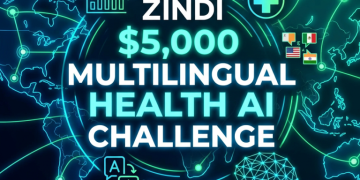






Artificial intelligence developers across Africa and beyond now have a new opportunity to build healthcare tools for underserved communities while competing for cash rewards.
- Artificial intelligence developers across Africa and beyond now have a new opportunity to build healthcare tools for underserved communities while...
- The Multilingual Health Question Answering in Low-Resource African Languages Challenge 2026 invites innovators to develop AI systems that can answer...
- The initiative comes as researchers continue to highlight gaps in AI performance for African languages.
- Winners will receive $2,500 for first place, $1,500 for second place, and $1,000 for third place.
Keep reading for the full breakdown on African AI — everything you need to know is covered below.
The Multilingual Health Question Answering in Low-Resource African Languages Challenge 2026 invites innovators to develop AI systems that can answer health-related questions in African languages often overlooked by mainstream technology platforms.
Hosted on the Zindi platform in partnership with the International Telecommunication Union and the Hub for Artificial Intelligence in Maternal, Sexual and Reproductive Health, the competition aims to improve access to reliable healthcare information in local African languages.


Focus on African Languages and Healthcare
Organisers say the challenge targets low-resource African languages, including Luganda, Kiswahili, Akan, and Amharic. Participants are expected to build multilingual AI models that can accurately understand and respond to health-related questions while maintaining fluency in the speaker’s original language.
The initiative comes as researchers continue to highlight gaps in AI performance for African languages. Recent studies show that many global AI systems still struggle with understanding African languages because most training datasets are heavily centred on English and other widely used languages.
Health experts also point to the growing role of AI-powered communication tools in healthcare delivery. New research warns that language technologies must become more inclusive and culturally aware to support safe healthcare communication across multilingual populations.
Prize Money and Participation Rules
The competition offers a total prize pool of $5,000. Winners will receive $2,500 for first place, $1,500 for second place, and $1,000 for third place. Participants can also earn additional Zindi leaderboard points during the challenge.

Applications are open to data scientists, AI researchers, machine learning engineers, NLP specialists, students, startups, and innovation teams worldwide. Contestants may participate individually or form teams of up to four members.
According to organisers, participants will gain hands-on experience in multilingual model training, large language models, AI benchmarking, and healthcare-focused AI development.
Key Dates and Evaluation Process
The challenge officially opened on April 30, 2026, and submissions will close on June 21, 2026. Final leaderboard results are expected shortly after the submission deadline.
Submissions will be assessed using multiple evaluation methods, including ROUGE-based scoring and AI-assisted judging systems. Organisers say the evaluation process will measure factual accuracy, contextual quality, and language fluency.
The competition reflects growing efforts to expand AI innovation for African communities by supporting tools that improve health literacy, digital inclusion, and access to local language technology.
Interested applicants should apply here.