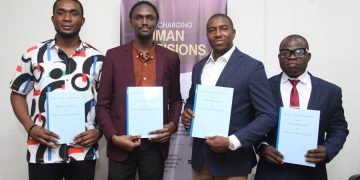






Decision Spaak and the Gbenga Fawehinmi Foundation (GFA) have launched a partnership aimed at expanding artificial intelligence education into Nigerian secondary schools, with a long-term target of training 10 million Africans in AI-related skills.
- Decision Spaak and the Gbenga Fawehinmi Foundation (GFA) have launched a partnership aimed at expanding artificial intelligence education into Nigerian...
- The initiative, announced in Lagos on Monday, June 22, 2026, is designed to extend AI learning beyond universities and professional...
- He explained that the partnership with GFA will broaden access to younger learners.
- He also highlighted a $50 million scholarship fund aimed at supporting learners who cannot afford specialised AI and analytics education.
Keep reading for the full breakdown on African AI — everything you need to know is covered below.
The initiative, announced in Lagos on Monday, June 22, 2026, is designed to extend AI learning beyond universities and professional settings into underserved communities, while equipping students with early digital literacy and problem-solving abilities.
President and Chief Executive Officer of Decision Spaak, Philip Adekambi, said the collaboration marks the company’s first structured entry into secondary education.


“We are on a mission to train 10 million Africans on AI,” Adekambi said, adding that the organisation already delivers training through educational technology platforms, universities, professional communities, and corporate organisations.
He explained that the partnership with GFA will broaden access to younger learners. “AI is not just for graduates or working professionals. It can also be for students in secondary schools who can begin to understand the technology early and apply it throughout their lives,” he said.
Adekambi noted that Decision Spaak has already trained more than 500,000 people across Africa through radio, television, podcasts, and structured training programmes. He also highlighted a $50 million scholarship fund aimed at supporting learners who cannot afford specialised AI and analytics education.
However, he said regulatory approvals and bureaucratic processes remain a challenge to faster expansion in Nigerian schools.

Board Member and Director of GFA, Gbenga Agboola, said the foundation has spent nearly two decades supporting vulnerable children through scholarships and mentorship programmes, adding that AI now offers a new pathway for impact.
“AI has changed the game. It allows us to bring technology closer to our communities and use it to spark development and creativity,” he said.
Head of Operations, Governance and Partnerships at GFA, Joshua Aremu, said the rollout will begin with a pilot phase before scaling to more schools across the country.
“We want this to be practical and hands-on. The goal is not just to expose students to AI but to ensure they can apply what they learn to solve problems and create value,” Aremu said.
Both organisations said they will collaborate with schools, community groups, and government agencies to widen access to AI education across Nigeria.