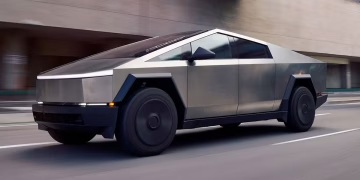






In a move that could entirely change the future of electric vehicles on the continent, Tesla is getting ready to make its first foray into the African market by selecting Morocco as its launchpad.
- In a move that could entirely change the future of electric vehicles on the continent, Tesla is getting ready to...
- Preparations are underway, as evidenced by the company’s posting of a leadership position for a Country Sales & Delivery Lead...
- Morocco is becoming Africa’s leader in electric vehicle production, going beyond conventional automobile manufacturing. In 2024, Morocco produced 40,000 to...
- The Moroccan government has contributed significantly to accelerating the EV industry. In addition to incentives for businesses that incorporate EVs...
Keep reading for the full breakdown on Africa — everything you need to know is covered below.
Preparations are underway, as evidenced by the company’s posting of a leadership position for a Country Sales & Delivery Lead in Casablanca. The candidate will be the face of Tesla’s brand and national expansion efforts as they drive sales, supervise vehicle deliveries, manage daily operations, and shape the company’s market strategy.
Why Morocco
The decision to enter Morocco instead of larger markets like South Africa underscores a shift in Africa’s automotive landscape. Morocco has quickly established itself as the continent’s emerging automotive powerhouse.



The nation produced 559,645 cars in 2024, a 5 per cent rise over the year before, while South Africa produced 599,755 vehicles, a 5 per cent decrease. Because of its robust industrial policies, efficient logistics, and investor-friendly environment, analysts predict that Morocco will surpass South Africa in terms of overall output.
Morocco is becoming Africa’s leader in electric vehicle production, going beyond conventional automobile manufacturing. In 2024, Morocco produced 40,000 to 50,000 electric vehicles (EVs), while South Africa has not yet manufactured a fully electric car. A more sophisticated charging infrastructure, with roughly 1,000 public charging stations—double South Africa’s 400–500 stations—supports this momentum.
Proximity to Europe further enhances the country’s appeal as an export hub, significantly reducing shipping costs for international manufacturers. The nation offers zero VAT and zero customs duties on electric vehicle imports, in addition to providing additional incentives for businesses incorporating EVs into their operations.
These policies are driving demand, with 1,125 EVs sold in 2024 and projections indicating a rise to 4,248 in 2025.

The Moroccan government has contributed significantly to accelerating the EV industry. In addition to incentives for businesses that incorporate EVs into their operations, the nation offers zero VAT and zero customs duties on electric vehicle imports. These policies are fueling demand; in 2024, 1,125 EVs were sold, and projections indicate that number will rise to 4,248 in 2025.
Tesla’s arrival to intensify competition in the African auto industry
Tesla’s arrival is expected to increase competition in the African auto industry. The massive Chinese EV manufacturer BYD is already making rapid progress in South Africa by installing charging stations, expanding its dealership network, and introducing more affordable models.
Tesla’s arrival may put pressure on other automakers to boost their investments in infrastructure, localised innovations, and production capacity, especially in North Africa, where manufacturing ecosystems are expanding rapidly.
This action should serve as a timely reminder for South Africa. EV adoption has been hampered by high import taxes, few incentives, and a lacklustre infrastructure, making the country at risk of losing its dominant position in a once-dominant industry.
Morocco is emerging as the continent’s most alluring EV hub, as international automakers are giving preference to nations with forward-thinking policies and efficient supply chains.
More than just a market entry, Tesla’s move into Africa is a sign that the continent is now considered a growth frontier by world leaders in electric vehicles. Morocco could shift regional competition and hasten the continent’s transition to electric mobility if it capitalises on this momentum and establishes itself as Africa’s main entry point for cutting-edge automotive technology.